The future circular of economy is rapidly becoming one of the most important global business and environmental transformations of this decade. As industries face rising waste, resource shortages, climate pressure, and stricter environmental regulations, governments and corporations are moving away from the old linear “take-make-dispose” system toward smarter regenerative models. The circular economy future is no longer a distant theory—it is an active roadmap for sustainable manufacturing, responsible consumption, and profitable innovation. By the end of this decade, experts believe that circular economy 2030 frameworks will redefine how products are designed, used, repaired, recycled, and reintroduced into supply chains. Current circular economy trends show a major increase in AI-based recycling, digital product passports, closed-loop manufacturing, and waste-to-resource systems. At the same time, broader sustainability trends are pushing businesses to adopt low-carbon and zero-waste operations. This article explores the strongest future of circular economy predictions, the role of emerging circular tech, and how emerging circular technologies will shape the global economy by 2030.
Understanding Why the Circular Economy Matters More Than Ever
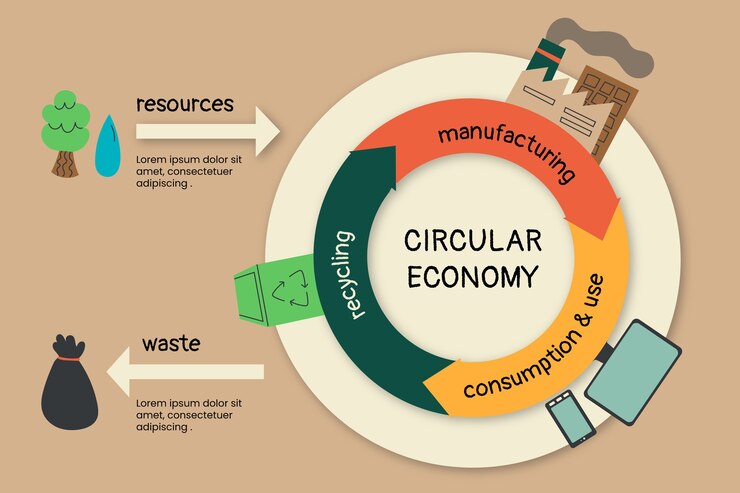
For over a century, the global economy has operated on a linear model. Raw materials are extracted, converted into products, sold to consumers, and discarded after use. This process creates enormous environmental damage, excessive landfill accumulation, and depletion of natural resources. Rising industrialization and consumerism have made this approach unsustainable.
The circular economy offers a very different vision. Instead of allowing products to become waste, materials remain in use for as long as possible through repair, refurbishment, remanufacturing, recycling, and sharing systems. In simple terms, the circular model keeps economic value circulating rather than throwing it away.
This shift is becoming urgent because the world is consuming resources faster than ecosystems can regenerate. Recent sustainability studies show that although circular adoption is increasing, global material consumption is still growing rapidly, which means businesses must move beyond basic recycling into deeper systemic redesign.
The future will therefore not be built on isolated recycling programs alone. It will be built on circular systems that change product ownership, product lifespan, industrial logistics, and digital material intelligence.
Why 2030 Is a Defining Deadline for Circular Transformation
The year 2030 is considered a global turning point because it aligns with:
- International climate commitments
- Net-zero carbon targets
- Sustainable Development Goals
- Plastic reduction mandates
- Extended producer responsibility laws
- Corporate ESG accountability frameworks
Many governments have already begun implementing policies that force brands to take responsibility for product waste, packaging recovery, electronic disposal, and textile reuse. These regulations are pushing companies to invest in redesign now rather than later.
Research across Europe and North America suggests that the period between 2025 and 2030 is the “execution phase” where circularity moves from pilot programs to mainstream industrial systems.
That means circular economy trends 2030 will not simply involve environmental campaigns—they will involve measurable business infrastructure, smart waste technology, and digital compliance systems.
Major Circular Economy Trends Shaping the Next Decade
1. Product Design for Long-Term Circularity
One of the strongest circular economy trends is circular design. Companies are no longer designing products only for sales; they are designing products for:
- easy repair,
- component replacement,
- modular upgrades,
- easy disassembly,
- material recovery.
Electronics, furniture, automotive parts, textiles, and appliances are increasingly being redesigned with lifecycle extension in mind.
This trend matters because around 80% of a product’s environmental impact is decided during the design phase. If products are built to last longer and to be dismantled efficiently, waste drops dramatically.
By 2030, many brands will likely be legally required to disclose recyclability, repairability, and material composition before products even reach consumers.
2. Closed-Loop Manufacturing Will Become Standard
Traditional manufacturing consumes virgin resources every production cycle. Circular manufacturing creates a loop where production waste, defective components, and used materials are fed back into the manufacturing line.
Industries such as:
- automotive,
- packaging,
- electronics,
- consumer goods,
- healthcare equipment
are already developing closed-loop systems because they lower procurement costs and reduce environmental liabilities.
Industrial reports suggest that circular manufacturing will dominate future sustainability investments because it combines environmental gains with direct cost efficiency.
This makes it one of the most powerful sustainability trends influencing global industrial growth.
3. Rise of Product-as-a-Service Business Models
The future circular economy will not always depend on ownership. Increasingly, businesses are shifting toward access-based models where customers lease, rent, or subscribe rather than purchase outright.
Examples include:
- electronics rental,
- machinery leasing,
- furniture subscription,
- shared mobility,
- industrial equipment service contracts.
Why does this matter?
Because when companies retain ownership, they have a financial incentive to build durable products, recover used assets, refurbish them, and redeploy them.
This business model reduces waste while generating recurring revenue. By 2030, many high-value sectors may earn more through product performance services than through one-time sales.
4. Reverse Logistics Networks Will Expand Globally
A circular economy cannot function without return systems.
Products need pathways back from consumers to:
- collection centers,
- repair hubs,
- remanufacturing plants,
- materials recovery facilities.
This is why reverse logistics is emerging as one of the fastest-growing operational sectors in sustainability.
By 2030, many companies will invest heavily in:
- smart collection bins,
- return labels,
- take-back programs,
- urban repair stations,
- retailer recovery partnerships.
This logistics layer is essential because circularity depends on material return rates, not just recycling intent.
Emerging Circular Technologies That Will Define Circular Economy 2030
Technology is the real engine behind scalable circularity. Without digital intelligence, circular systems remain slow, expensive, and difficult to monitor.
Here are the most important emerging circular technologies transforming the next decade.
AI-Powered Waste Sorting and Material Recognition
Artificial Intelligence is becoming central to recycling and remanufacturing. Advanced vision systems can now identify:
- plastic grades,
- mixed material contamination,
- metal composition,
- food waste categories,
- textile fibers.
AI sorting systems are significantly faster and more accurate than manual sorting, which means higher material purity and lower operational cost. Current industrial sustainability reports identify AI-enabled sorting as one of the most commercially important emerging circular tech investments heading into 2030.
This will dramatically improve the economics of recycling industries.
Internet of Things for Asset Tracking
Reusable products only create circular value if businesses know where they are, when they return, and what condition they are in.
IoT sensors are increasingly attached to:
- pallets,
- reusable packaging,
- industrial containers,
- rental devices,
- medical equipment.
These sensors monitor location, wear, damage, and usage cycles.
As a result, businesses can predict maintenance needs, reduce loss, and maximize repeated circulation. This makes IoT one of the most practical emerging circular technologies for supply chain efficiency.
Blockchain for Material Transparency
One major problem in current recycling systems is traceability. Manufacturers often do not know:
- where raw materials came from,
- whether they are recycled,
- how many times they have been reused,
- what chemicals they contain.
Blockchain-based digital ledgers solve this by creating verified material histories.
This is especially useful for:
- electronics,
- batteries,
- textiles,
- food packaging,
- medical plastics.
By 2030, digital material passports are expected to become common compliance tools across international trade systems.
Robotics in Disassembly and Remanufacturing
Manual disassembly is expensive and slow. Robotics can dismantle products faster and recover components without damaging them.
Future circular factories are expected to use robotic systems for:
- battery extraction,
- smartphone component recovery,
- appliance part separation,
- automotive remanufacturing.
This reduces labor cost while increasing material value retention.
Bio-Based Recycling and Advanced Material Science
Some waste streams are too complex for traditional recycling. This is where biotechnology enters the circular economy.
Scientists are now developing:
- enzyme-based plastic breakdown,
- bio-compostable industrial materials,
- molecular recycling systems,
- regenerative packaging.
These systems can recover usable molecules even from difficult waste streams, making circularity more realistic for plastics and composites.
Sustainability Trends Driving Circular Business Adoption
The circular shift is not happening in isolation. It is connected to larger sustainability trends that are changing consumer expectations and investor behavior.
Carbon Accountability
Businesses are now evaluated not only on profit but also on lifecycle emissions. Circularity reduces emissions because reused materials generally require less energy than virgin extraction.
ESG Investment Pressure
Investors increasingly fund companies that demonstrate:
- waste reduction,
- traceable sourcing,
- regenerative product systems,
- resource efficiency.
Circularity is becoming a strong ESG performance indicator.
Consumer Demand for Responsible Brands
Customers, especially younger generations, increasingly support brands that offer:
- refillable packaging,
- buy-back options,
- recycled products,
- repair services.
This social pressure is accelerating circular adoption beyond regulation.
Resource Price Volatility
Virgin materials are becoming more expensive due to supply disruptions and geopolitical instability. Circular sourcing creates resilience by reducing dependence on new extraction.
These sustainability trends make circularity financially strategic, not just environmentally desirable.
Industry Sectors That Will Lead the Circular Economy Future
Fashion and Textiles
The fashion industry is under massive pressure because of textile waste. By 2030 we can expect:
- resale-first retail models,
- textile fiber recycling,
- clothing rental platforms,
- digital garment passports.
Electronics
E-waste is one of the fastest-growing global waste streams. Circular electronics will focus on:
- repairable devices,
- upgradeable components,
- take-back manufacturing,
- certified refurbished markets.
Automotive
Electric vehicle batteries, tires, metals, and plastics are creating huge opportunities for remanufacturing and second-life usage.
Construction
Construction waste recovery, modular buildings, and reusable structural materials will become mainstream.
Packaging
Reusable packaging loops, compostable materials, and AI-sorted plastics will dominate FMCG sustainability planning.
Future of Circular Economy Predictions for 2030
Now let us look at the strongest future of circular economy predictions based on present industrial momentum.
Prediction 1: Circularity Will Become a Core Corporate KPI
Companies will no longer treat circularity as a CSR side project. It will become a board-level performance metric tied to:
- procurement,
- manufacturing,
- packaging,
- customer retention,
- emissions.
Prediction 2: Waste Will Be Classified as an Economic Resource
Instead of landfill cost, waste streams will be measured as recoverable asset pools. Businesses will calculate material recovery value in financial reports.
Prediction 3: Digital Product Passports Will Become Mandatory
Products will carry scannable digital identities containing:
- source materials,
- repair instructions,
- recycling pathways,
- carbon footprint,
- ownership history.
Prediction 4: Circular Jobs Will Increase Rapidly
Repair engineering, remanufacturing management, sustainable logistics, material analytics, and reverse supply chain software will become major employment sectors.
Closed-loop case studies already show circular models generating both environmental and workforce benefits.
Prediction 5: Circular Economy Market Value Will Surge
Analysts project major growth in digital circular business platforms, with AI, blockchain, and cloud-based circular systems expanding sharply by 2030. Some digital circular economy markets are projected to triple within this decade.
Challenges That Could Slow Progress
Even with optimism, the circular transition faces barriers:
- weak collection infrastructure,
- consumer disposal habits,
- low-quality mixed waste,
- high upfront technology cost,
- inconsistent regulations across countries,
- poor collaboration between suppliers.
Experts also warn that recycling alone cannot solve overconsumption. True circularity requires reduction, repair, and reuse before recycling.
So the future depends not only on technology, but also on policy discipline and behavior change.
How Businesses Should Prepare Now for Circular Economy 2030
Businesses that want to stay competitive should begin with:
- lifecycle audits,
- recyclable product redesign,
- take-back infrastructure,
- supplier transparency systems,
- AI waste analytics,
- reverse logistics partnerships,
- circular procurement goals.
The companies investing now will have the strongest cost and compliance advantage by 2030.
Final Thoughts
The circular economy future is moving from vision to industrial reality. The next few years will determine whether businesses remain trapped in expensive linear systems or evolve into regenerative value networks. The most important circular economy trends show that circularity is no longer limited to recycling bins and sustainability reports—it now includes AI sorting, blockchain traceability, digital material passports, robotic remanufacturing, and service-based ownership. These emerging circular technologies are setting the stage for circular economy 2030, where waste becomes resource, ownership becomes access, and manufacturing becomes regenerative. The strongest future of circular economy predictions suggest that brands embracing emerging circular tech early will not only reduce environmental impact but also unlock long-term profit, customer loyalty, and supply chain resilience. In short, the future circular economy will belong to organizations that understand one simple truth: sustainability is no longer separate from business growth—it is the foundation of it.
About the Author