Did you know that the average garment today is worn only seven to ten times before being discarded? We are living in an era of “planned fragility,” where clothing and furniture are designed to fail just as the next trend arrives. However, there is a glitch in this linear system: the thrift store. Second-hand shops are effectively “time capsules” of material quality. Because items from 20, 30, or 40 years ago were built with “technical nutrients”—solid wood, natural fibers, and robust joinery—they often possess more life today than a brand-new item from a big-box retailer.
Thrift store shopping is the front line of the circular economy. Every time you choose a pre-owned item, you are “de-funding” the linear manufacturing loop and preventing the massive carbon expenditure required for new production. This guide provides a strategic roadmap for finding quality second-hand items, detailing how to identify high-quality clothing at thrift stores, revealing the best days for thrift store shopping, and teaching you the art of spotting durable furniture at second-hand shops.
I. The Second-Hand Economic Rebellion
We must stop viewing thrift stores as “charity” and start viewing them as “resource recovery centers.”
The Problem of the New-Item Bias
Buying new, mass-produced “fast” goods when high-quality second-hand alternatives exist is an act of fiscal and environmental self-sabotage.
New products in the linear economy are optimized for “logistics and price,” not “use and longevity.” This results in particle-board furniture and polyester-blend clothing that cannot be repaired. Second-hand items have already passed the “stress test” of time. If a chair has lasted 40 years, it is structurally sound. By practicing second-hand shopping strategies, you are acquiring superior materials at a fraction of the cost, while keeping the “embedded energy” of those materials in use.
A consumer buys a new 40 “fast-fashion” blazer made of polyester. Within six months, the seams fray and the fabric pilled. Another consumer uses thrift store shopping to find a 1980s 100% wool blazer for 15. The wool is breathable, the construction is impeccable, and it will last another 20 years. The second consumer saved 25 and acquired a significantly higher-value asset that is fully circular.
Therefore, finding quality second-hand items is the ultimate “wealth hack” in a circular economy—it allows you to live at a higher material standard while lowering your environmental footprint.
II. How to Identify High-Quality Clothing at Thrift Stores
In a sea of fast-fashion “noise,” you must train your hands and eyes to find the “signals” of quality.
1. The “Fiber First” Rule
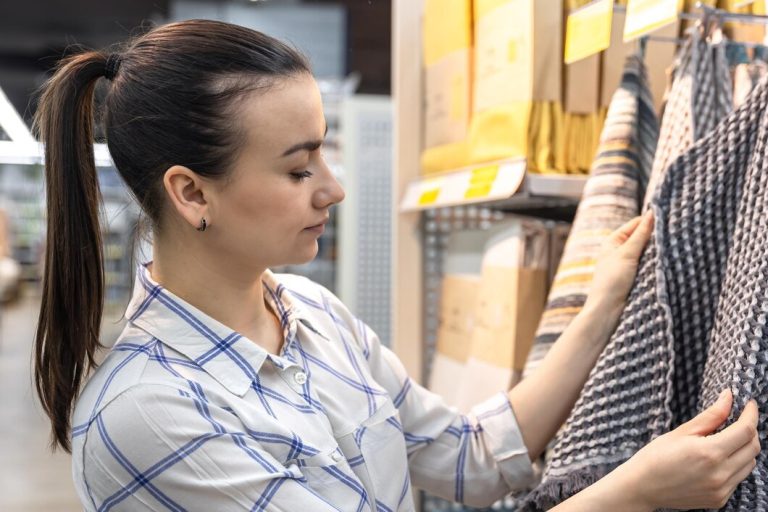
Avoid the tag and touch the fabric. Natural fibers are “biological nutrients” that age gracefully.
- Look for: Silk, wool, linen, and 100% cotton.
- Avoid: Heavy “poly-blends” (e.g., 60% polyester, 40% cotton), which trap odors and pill easily.
- The “Scrunch Test”: Squeeze the fabric in your fist for five seconds. If it stays heavily wrinkled, it’s low-quality fiber. If it bounces back, it’s a high-quality weave.
2. Inspect the “Hardware” and Seams
- Zippers: Are they metal (YKK) or cheap plastic? Metal indicates a manufacturer who wasn’t cutting corners.
- Seams: Turn the garment inside out. Look for “serged” edges or “french seams.” If you see loose threads or “puckering,” the garment was made too fast and won’t last.
- Buttons: High-quality garments often have “mother of pearl” or horn buttons and usually include a spare on the interior tag.
III. Spotting Durable Furniture at Second-Hand Shops
Furniture is the “heavy lift” of the circular economy. Spotting durable furniture at second-hand shops requires looking past ugly upholstery or outdated stains to the “bones” of the piece.
1. The “Lift and Shake” Test
If a dresser or chair feels surprisingly heavy for its size, it is likely solid wood rather than particle board (MDF). Give it a gentle shake; if it wobbles at the joints, it may need repair, but if it’s solid, it’s a keeper.
2. Dovetail Joinery
Pull out a drawer. Look at the corner where the front meets the side. If you see interlocking “teeth” (dovetails), you have found a high-quality, handcrafted piece. If it is just glued or stapled, it is a “linear-era” disposable item.
3. “Good Bones” Potential
Don’t be afraid of scratches. Solid wood can be sanded and refinished (Article ID 73). Focus on the silhouette and the structural integrity.
IV. Best Days for Thrift Store Shopping
Timing is a critical component of successful second-hand shopping strategies.
- Monday and Tuesday: These are traditionally the best days. Most people clear out their homes over the weekend, and thrift stores spend Monday morning processing these new “resource inflows.”
- Mid-Week (Wednesday/Thursday): Stores are often less crowded, allowing you to browse the “new arrivals” that haven’t been picked over by the weekend crowds.
- The “End of Month” Surge: Many people donate items when they move house, which typically happens at the end of the month. This is the best time for finding quality second-hand furniture and large appliances.
V. Strategic ROI: The Savings of the Loop
| Item | Retail Price (New/Low Quality) | Thrift Price (High Quality) | Circular ROI |
| Wool Overcoat | 200.00 (Blend) | 25.00 (100% Wool) | 175.00 |
| Solid Oak Nightstand | 150.00 | 20.00 | 130.00 |
| Cast Iron Skillet | 40.00 | 8.00 | 32.00 |
| Designer Jeans | 120.00 | 12.00 | 108.00 |
- Asset Value: High-quality second-hand items often hold their value. If you buy a vintage Eames-style chair at a thrift store, you can likely sell it for the same price (or more) years later. This is “Zero-Cost Ownership.”
VI. Ethical Thrift: The Circular Responsibility
While thrift store shopping is sustainable, it carries a social responsibility.
- Avoid “Over-Thrifting” Basics: If you can afford new, sustainable basics, leave the ultra-low-priced “essential” items for those who rely on thrift stores for survival.
- The “One-In, One-Out” Rule: To keep your own household loop closed, for every item you bring home from a thrift store, donate or sell one item back into the system.
- Support Local Charities: Choose shops where the proceeds support local social causes, doubling the impact of your circular choice.
Conclusion: Becoming a Resource Scout
The thrift store is not a graveyard for old things; it is a warehouse of untapped potential. Finding quality second-hand items is a skill that turns the tide against the “disposable” economy.
By mastering how to identify high-quality clothing at thrift stores and understanding the best days for thrift store shopping, you transform from a “consumer” into a “resource scout.” You aren’t just saving money; you are performing the vital work of the circular economy by keeping the best materials of the past in high-utility service for the future.
About the Author