Did you know that the fashion industry produces an estimated 92 million tons of textile waste every year? That is the equivalent of a garbage truck full of clothes being dumped in a landfill every single second. Most of these garments are made from synthetic blends that will take 200 years to decompose, leaching microplastics into our soil and water. In a linear economy, “old” is synonymous with “worthless.” But in a circular economy, every fiber represents an investment of water, energy, and labor that is too valuable to lose.
Textile upcycling is the radical act of reclaiming that value. Unlike downcycling—where clothes are shredded into low-grade insulation—upcycling clothes elevates the material, creating something of higher quality or aesthetic value than the original. This guide provides a strategic roadmap for how to turn old clothes into new items, explores the environmental benefits of textile upcycling, and offers a curated list of beginner upcycling projects for clothes to transform your wardrobe into a closed-loop system.
I. The Myth of “Disposable” Fabric (The OREO Framework)
The modern consumer has been conditioned to view clothing as a fast-moving consumable rather than a durable asset.
The Problem of the “Cheap” T-Shirt
Opinion: The concept of “disposable clothing” is a dangerous economic fiction that ignores the true cost of raw material extraction and manufacturing.
Reason: A single cotton T-shirt requires approximately 2,700 liters of water to produce—enough for one person to drink for two and a half years. When we discard that shirt because of a small stain or a change in trend, we are throwing away that water, the energy of the loom, and the carbon cost of shipping. Repurposing fabric isn’t just a craft; it is the necessary recovery of high-value “technical and biological nutrients” that the linear system is designed to waste.
Example: A consumer has a pair of 100% cotton denim jeans with a torn inner thigh. In a linear model, these go in the trash. In an upcycling model, that high-grade, durable denim is harvested. The legs become a sturdy tote bag, and the pockets become a wall-mounted tool organizer. The material’s life is extended by a decade, and the need for a new, resource-heavy bag is eliminated.
Opinion/Takeaway: Therefore, textile upcycling is the ultimate expression of resource efficiency—it is the process of treating every scrap of fabric as a precious raw material rather than a burden.
II. Benefits of Textile Upcycling: Beyond the Craft Room
While upcycling is often viewed as a “DIY hobby,” its implications for sustainable business models are profound.
- Carbon Footprint Reduction: Upcycling skips the most carbon-intensive stages of the fashion lifecycle: fiber production, spinning, and dyeing. By using existing fabric, you eliminate the demand for “virgin” resources.
- Microplastic Mitigation: By repurposing fabric rather than sending it to a landfill or incinerator, we prevent the mechanical breakdown of synthetic fibers into the environment.
- Economic Resilience: Upcycling teaches the “value of the make.” It shifts the consumer’s focus from the price tag to the quality of the fiber, fostering a localized economy of makers and repairers.
III. How to Turn Old Clothes into New Items: The Technique Hierarchy
To master upcycling clothes, you must understand the three primary methods of transformation.
1. The Aesthetic Upgrade (Visible Mending)
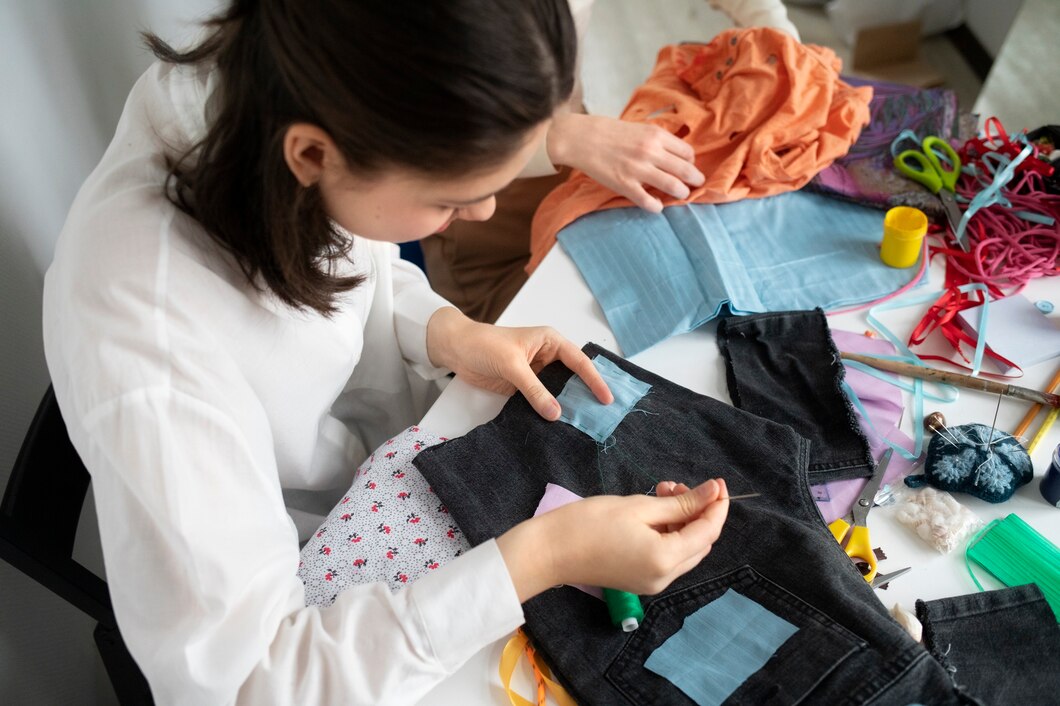
This involves taking a garment that is slightly damaged and using embroidery, patches, or darning to make the “flaw” a focal point. This is the simplest form of textile upcycling.
2. The Structural Re-Design
This is the process of taking a garment apart and using the fabric to create a different type of clothing.
- Example: Turning an oversized men’s button-down shirt into a child’s dress or a woman’s wrap top.
- Technique: Deconstruct the original item at the seams to maximize the amount of flat fabric available for your new pattern.
3. The Functional Transformation
This is where the garment ceases to be clothing and becomes a household asset.
- Example: Creating “T-shirt yarn” from old jerseys to crochet durable rugs or baskets.
IV. Beginner Upcycling Projects for Clothes
If you are new to textile upcycling, start with these three high-impact, low-difficulty projects.
Project 1: The Zero-Waste Produce Bag
- Source Material: Old lace curtains or thin cotton T-shirts.
- The Process: Cut two rectangles, sew three sides, and create a drawstring channel at the top.
- Value: Replaces single-use plastic bags at the grocery store while repurposing fabric that is often hard to donate.
Project 2: The Denim Tool Roll or Cosmetic Bag
- Source Material: Old jeans (the most durable upcycling resource).
- The Process: Use the leg section of the jeans. The weight of the denim is perfect for protecting sharp tools or makeup brushes.
Project 3: Memory Quilts or Pillow Covers
- Source Material: Sentimental clothes that no longer fit (baby clothes, concert tees).
- The Process: Cut the graphics into uniform squares and sew them into a grid.
- Value: Preserves the history of the garment while creating a functional home decor item.
V. Harvesting Fabric Scraps Projects
The hallmark of a true circular maker is the “No Scrap Left Behind” policy. Even the tiny pieces left over from larger textile upcycling projects have utility.
- Pet Bed Stuffing: Shred even the smallest scraps and use them as high-quality, washable stuffing for pet beds.
- Beeswax Wraps: Small squares of 100% cotton can be infused with beeswax to create reusable food wraps, replacing plastic cling film.
- Braided Rugs: Long, thin strips of almost any fabric can be braided and sewn into circular rugs for bathrooms or entryways.
VI. The Economic ROI of the Upcycled Wardrobe
| Upcycling Project | Cost of Raw Materials | New Product Value | Environmental Saving |
| Jeans to Tote Bag | 0.00 | 45.00 | 10,000L Water |
| Shirt to Produce Bags | 0.00 | 15.00 | 20+ Plastic Bags/Year |
| Sweater to Mittens | 0.00 | 30.00 | Animal Welfare/Wool Energy |
By choosing to upcycle clothes, you are essentially “mining” your own closet for free, high-quality materials.
Conclusion: The New Life of Fibers
The tragedy of the linear fashion model is that it treats beautiful, durable textiles as if they have an expiration date. Textile upcycling proves that there is no such thing as “away” when we throw something out; it just goes somewhere else.
How to turn old clothes into new items is a skill that combines creativity with systemic responsibility. By embracing upcycling clothes and finding new uses for fabric scraps, you move from being a passenger in the fast-fashion cycle to being a producer in the circular economy. Your clothes have stories—upcycling ensures those stories have many more chapters to come.
About the Author