The fashion industry has become the poster child for the linear “take-make-dispose” economy. We now buy 400% more clothing than we did 20 years ago, and globally, a garbage truck full of textiles is landfilled or burned every second. The result is a monumental waste of water, cotton, and synthetic materials, driven by cheap prices and a culture that views a missing button or a small tear as a reason for disposal.
The most potent countermeasure to fast fashion is the simple act of clothing repair. Mending a garment is a radical act of circularity—it retains 100% of the item’s embodied energy and material value, saving you money and fighting textile waste. This clothing repair guide details the essential clothing repair skills for mending clothes at home, showing you exactly how to repair clothes at home and empowering you to embrace the longevity of a true circular wardrobe.
I. The True Cost of Textile Waste (The OREO Framework)
The ease of disposal has blinded consumers to the true resource cost of every garment they own.
The Value of the Thread
Opinion: The disposable mindset surrounding textiles proves that consumers fundamentally undervalue the finite resources and vast labor embedded in their clothing.
Reason: Producing one cotton t-shirt requires approximately 2,700 liters of water—enough to sustain one person for 2.5 years. When that t-shirt is discarded due to a small hole, 100% of that water, all the dye, and all the processing energy are lost. A small repair (a few pennies worth of thread and a minute of labor) is the only act that successfully retains that colossal initial investment.
Example: Mark’s favorite pair of jeans rips slightly at the knee. In the linear model, he replaces the jeans ($80), and the old pair goes to a scrap pile. In the circular model, he uses a simple mending clothes technique, applying a contrasting denim patch with a visible stitch (a visible mending aesthetic). The repair costs under $1 and extends the life of the jeans by two years, preventing the purchase of a new pair and transforming the garment into a unique, personal asset.
Opinion/Takeaway: Therefore, mastering clothing repair is not a sign of frugality; it is the most efficient form of textile repair and a critical skill for any advocate of the circular economy to fight consumption and waste.
II. Essential Clothing Repair Skills: The Core Toolkit
You don’t need a professional sewing machine to start. The essential tools for garment repair are simple, cheap, and fit in a small box.
The Repair Kit Checklist
- Needles: A basic assortment of hand-sewing needles (small and medium sizes).
- Thread: High-quality polyester or cotton thread in black, white, and a few colors that match your most-worn items.
- Thimble: Essential for pushing needles through thick fabric (like denim).
- Seam Ripper: The key to removing broken seams or mistakes cleanly.
- Small Scissors: Sharp scissors dedicated to cutting thread.
- Safety Pins/Clips: For temporarily holding fabric while you work.
Basic Mending Clothes Skills to Master
| Skill | Problem Solved | How to Repair Clothes at Home |
| Sewing a Button | Missing buttons (the most common failure). | Use a double thread. Pass the needle through the fabric, leaving a small space (a matchstick works well) under the button to create a thread shank. This prevents the button from ripping out. |
| Simple Hem Stitch | Pants or skirts are too long or have a fallen hem. | Use a slip stitch or blind hem stitch to secure a fold in the fabric. This skill is critical for achieving a perfect fit. |
| Closing a Seam | A seam along a pant leg or sleeve has split. | Use a simple backstitch, which is the strongest hand stitch, to secure the two pieces of fabric together. |
III. Fixing Damaged Garments Yourself: Intermediate Repairs
Once you’ve mastered the basics, move on to higher-value textile repair—the repairs that prevent a garment from being discarded.
1. Patching a Hole:
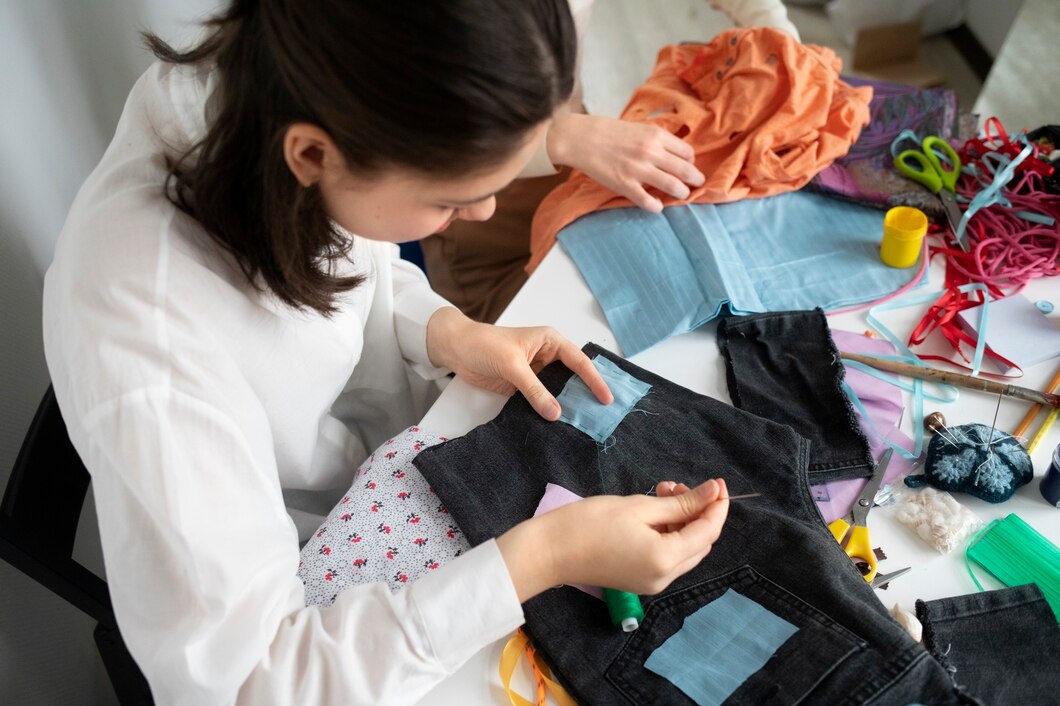
- The Method: Cut a patch of similar fabric (ideally from an old, discarded garment) slightly larger than the hole. Pin it in place. Use a running stitch or a zigzag machine stitch to secure the patch, ensuring all frayed edges are caught.
- The Circular Aesthetic: Use “visible mending,” where the patch is intentionally bright or contrasting. This celebrates the longevity of the garment and proves it has a history of care.
2. Zipper Repair:
The zipper is the most common reason to discard trousers or jackets.
- The Quick Fix: Often, the zipper is fine, but the puller (the slider) has simply separated or become damaged. Replacement pullers are available online and can often be clipped or sewn on without replacing the entire zipper tape.
- The DIY Fix: For minor issues, use pliers to gently squeeze the zipper puller’s opening to tighten its grip on the teeth, often fixing a zip that won’t stay closed.
3. The Simple Reinforcement:
Use iron-on patches or simple patches to reinforce high-wear areas before a hole forms (e.g., inner thighs of jeans, elbows of sweaters). This proactive garment repair extends the life cycle significantly.
IV. The Economic Case for Mending Clothes
The commitment to clothing repair saves money in two crucial ways: by eliminating constant replacement and by building a higher-quality, longer-lasting wardrobe.
- Calculated Savings: If you save replacing just three items a year (a pair of trousers, a shirt, and a jacket) with an average cost of $150, you save **$450 annually**—all for the price of a $10 repair kit.
- Value Retention: A professionally maintained or personally mended garment holds its value far better in the second-hand or resale market, making garment repair a smart investment.
The Circularity Metric:
Track your Cost Per Wear (CPW). By extending the life of a $100 jacket from 50 wears to 150 wears through repair, you reduce the CPW from $2.00 to $0.66, proving the economic superiority of the circular model.
Conclusion: Repair is the New Black
The linear economy has convinced us that clothes are disposable. The circular economy proves that durability and repair are the most fashionable, economically sound, and environmentally responsible choices.
By mastering the essential clothing repair skills and adopting the repair-first mindset, you join the “Right to Repair” movement and actively fight the waste of fast fashion. How to repair clothes at home is simple—all you need is a needle, thread, and the commitment to value the resources you already own. Start by fixing that missing button today.
About the Author