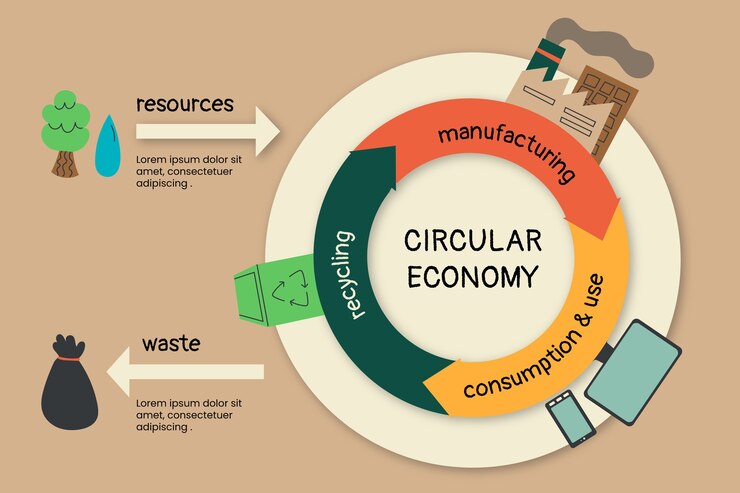
Did you know that according to the Ellen MacArthur Foundation, cities produce over 50% of global waste but also hold the key to 80% of the world’s GDP? In the linear economy, cities were designed as “sinks”—huge consumption centers where resources enter and “waste” is hauled away to distant landfills at a massive taxpayer cost. However, a global shift is occurring. Forward-thinking cities are reimagining themselves as “hubs” of resource circulation. Your city is likely sitting on a goldmine of circular infrastructure that you are already paying for through your taxes, but might not be using. Municipal circular economy programs are the formal, public-sector version of the hyperlocal circular economy.
By moving beyond the simple blue recycling bin, cities are launching city-led sustainability initiatives that range from tool libraries to industrial-scale composting. This guide provides a strategic roadmap for how to find circular economy programs in my city, detailing the benefits of municipal composting for residents, and teaching you how to maximize accessing public electronic waste disposal to build a low-carbon, high-utility lifestyle.
I. From Disposal to Management: The City’s New Role
We must stop viewing the city as a “garbage man” and start viewing it as a “resource broker.”
The Problem of the “Blind Sink”
Any city that still measures its success by “Waste Diversion Rates” alone is stuck in a linear mindset; a truly circular city must measure its success by “Resource Utilization Rates.”
“Diversion” is a negative metric—it’s about what doesn’t go to the landfill. “Utilization” is a positive metric—it’s about how many times a single tool or molecule is reused within city limits. When a city implements municipal circular economy programs, it is actively preventing the need for its citizens to buy new goods. This keeps capital in the pockets of residents and reduces the city’s total “carbon leakage.” The linear model thrives on the “efficiency of hauling”; the circular model thrives on the “efficiency of sharing.”
A city launches a municipal composting program and a “compost give-back” day. Instead of spending $1 million to haul organic waste to a landfill (where it produces methane), the city processes it locally. It then gives the nutrient-rich soil back to residents for free. The residents save money on garden supplies, the soil captures carbon, and the city avoids the landfill tipping fees.
Therefore, local government recycling and circular programs are the most powerful financial tools a city has—they turn a “cost center” (waste) into a “wealth center” (resources).
II. How to Find Circular Economy Programs in My City
Because these programs are often run by different departments (Public Works, Parks & Rec, Sustainability Office), they can be hard to track. Use this “Circular Audit” to find what’s available:
1. The “Waste Wizard” and Recycling Directories
Most modern cities have a digital “Waste Wizard.” You type in an item (e.g., “old toaster” or “sofa”), and it tells you the specific local government recycling path.
- The Goal: Look for “Hard-to-Recycle” events or permanent e-waste collection hubs. These are often subsidized by Extended Producer Responsibility funds.
2. The Public Library “Library of Things”
Check your library’s online catalog. Many public libraries now host city tool libraries or lend out baking equipment, seeds, and even energy-auditing kits. This is the ultimate example of public resource sharing.
3. Municipal “Swap Shops”
Some forward-thinking cities have “Last Chance” or “Swap Shops” at their transfer stations. Before an item is sent to the landfill, it is placed in a public area for anyone to take for free. This is city-led sustainability at its most functional.
III. Benefits of Municipal Composting for Residents
Municipal composting is the bridge between urban life and the “biological nutrient” cycle (Article ID 85).
- Nutrient Recovery: Cities are “nutrient sinks” where food arrives from farms but the waste is buried. Large-scale composting returns those nutrients to the earth.
- Methane Mitigation: Organic waste in landfills produces methane, a greenhouse gas 25x more potent than CO2. Municipal programs manage the decomposition process to prevent this.
- Cost Efficiency: For the resident, using city-led composting is usually cheaper than private services or the “cost” of the garbage bags required to throw food away.
IV. Accessing Public Electronic Waste Disposal
Electronics contain “technical nutrients” that are too valuable to lose.
- Permanent E-Waste Hubs: Check if your city has a dedicated center for “Technological Recovery.” These centers often partner with electronics parts harvesting programs.
- Curbside E-Waste Pickup: Some cities now offer specific “On-Call” pickups for electronics to ensure they are handled through producer accountability channels.
- Data Security: Verified municipal circular economy programs provide certificates of “Secure Data Destruction,” which is a service that private, unverified recyclers often skip.
V. The Strategic ROI: The “Public Dividend”
| Service Category | Private Cost (Est. Annual) | Municipal Program Cost | Circular ROI |
| Tool Rental (5 uses) | 250.00 | 0.00 (Library) | 250.00 |
| Compost/Soil (10 bags) | 100.00 | 0.00 (Give-back) | 100.00 |
| Hazardous Waste Disposal | 50.00 | Included in Taxes | 50.00 |
| Total Resident Savings | 400.00 |
- Home Value ROI: Neighborhoods with active city-led sustainability programs often have higher property values because they are cleaner and have more robust community ties.
- Tax ROI: For every 10% of waste a city diverts to circular programs, the municipal budget can save millions in tipping fees and hauling costs.
VI. City-Led Sustainability: What to Demand in 2026
If your city is still only offering basic recycling, it’s time for policy advocacy. Demand:
- Zero-Waste Procurement: The city should only buy repairable products.
- Repair-Friendly Zoning: Allow for “Repair Hubs” in residential areas to encourage local sustainability initiatives.
- Transparency Dashboards: A public website showing exactly where the city’s resources are going and how much carbon is being saved through circularity.
Conclusion: Activating Your Local Loop
Your city is more than just a collection of buildings and roads; it is a massive, untapped engine of the circular economy. Municipal circular economy programs are the gears that make the system move.
How to find circular economy programs in my city is the first step in reclaiming your role as a partner in urban metabolism. By using city tool libraries, participating in municipal composting, and accessing public electronic waste disposal, you prove that the “Circle” is not an abstract theory—it is a functional, local reality. Stop paying for waste. Start using your resources. The city has provided the tools; it’s time for you to pick them up.
About the Author