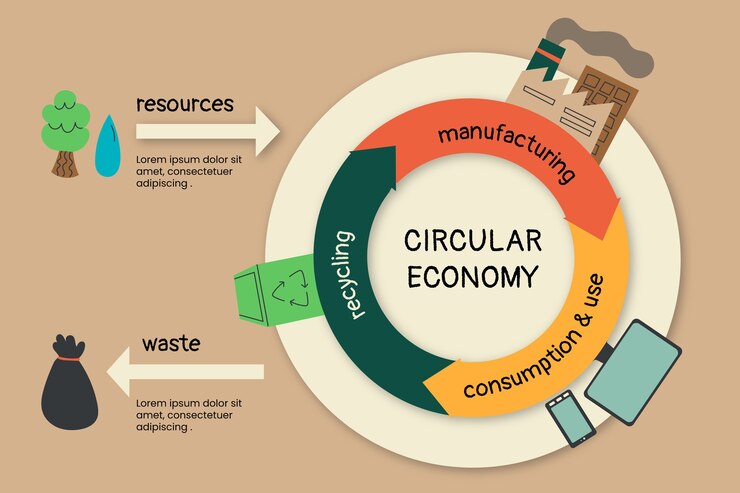
Did you know that by the time a child born today reaches their 18th birthday, they will have personally influenced the disposal of over 30,000 pounds of waste in a traditional linear economy? For decades, our approach to “environmental education” has been reactive: we teach children to pick up litter and sort their recycling. While well-intentioned, this focuses on the “end of the pipe.” It accepts waste as an inevitability. In a circular economy, we teach that waste is a design flaw. If we want to solve the climate crisis, we must move beyond “cleaning up” and start “designing out.” Circular economy education is about more than “being green”—it is about equipping the next generation with the systems-thinking skills required to thrive in a resource-constrained world.
This guide provides a strategic roadmap for teaching kids sustainability, detailing how to explain the circular economy to a child, exploring engaging circular economy activities for teens, and showing how to embed sustainable practices for teens into daily life to build a truly restorative future.
I. From Recycling to Resign: The New Pedagogy
We must shift the educational focus from “What do I do with this trash?” to “Why was this trash created in the first place?”
The Problem of the “Disposable” Mindset
Teaching children that recycling is the primary solution to environmental issues is a form of “Sustainability Lite” that fails to prepare them for the reality of the circular transition.
Recycling is often a “downcycling” process that requires massive energy and still results in material loss. If a child believes the blue bin “fixes” the problem, they continue to participate in the high-velocity linear consumption model. We must teach circular design for kids, focusing on the “R’s” that come before recycling: Refuse, Rethink, Reduce, and Repair. By teaching a child to value the material over the object, we turn them into resource managers. The linear model wants them to be “Good Recyclers”; the circular model requires them to be “Critical Designers.”
A teacher shows a class a standard juice box (a “monstrous hybrid” of paper, plastic, and foil). Instead of asking “In which bin does this go?”, they ask “How would you design this so it never has to be a bin at all?” (Example: A refillable glass bottle or a compostable wax-coated paper skin). One question teaches a chore; the other teaches circular economy education and innovation.
Therefore, teaching kids sustainability must be rooted in “Systems Thinking”—it is the only way to move the next generation from passive consumers to active architects of the loop.
II. How to Explain the Circular Economy to a Child
The concept of “Circular vs. Linear” can be complex, so we use the “Nature is Never Wasteful” analogy.
1. The “Forest vs. Factory” Story
- The Linear Factory: Explain that a factory takes things from the earth, makes something, and then it becomes “trash” that stays in a hole forever. It’s like a straight line that ends in a wall.
- The Circular Forest: Explain that in a forest, there is no trash. When a leaf falls, it becomes food for a bug. When the bug dies, it becomes food for the soil. The soil grows a new tree. It’s a perfect circle.
- The Goal: Help the child realize that humans are the only ones who made the “straight line” (linear), and our job is to make things like the “circle” (circular).
2. The “Library of Things” Game
Explain the concept of access without ownership. Ask: “Does everyone on the street need their own swing set, or could we share one big, amazing park?” This introduces the sharing economy at a level a five-year-old can understand.
III. Engaging Circular Economy Activities for Teens
Teens have the cognitive capacity for “Technical Nutrients” and “Business Models”. Use their desire for autonomy and “fairness” to drive sustainable practices for teens.
- The “Tear-Down” Lab: Provide old, broken electronics (printers, remote controls) and a set of screwdrivers. Challenge them to find the “Repair Barriers”.
- Question: “Is this glued shut or screwed? Can you find the motor? Could this motor be used in a robot?” This is electronics parts harvesting as an educational tool.
- Question: “Is this glued shut or screwed? Can you find the motor? Could this motor be used in a robot?” This is electronics parts harvesting as an educational tool.
- The “Fast Fashion” Audit: Have teens look at the labels in their favorite clothes.
- Activity: Research the “Material DNA.” Is it a “Monstrous Hybrid” (Poly-Cotton blend) or a “Pure Nutrient” (100% Cotton)?
- The Goal: Encourage clothing rental or hosting swap events as a trendy, high-status alternative to buying new.
- Circular Business Challenge: Ask them to take a linear product (like a disposable coffee pod) and design a “Product-as-a-Service” business model for it.
IV. Classroom Sustainability Projects: Scaling the Loop
Schools are the “Mini-Cities” where circularity can be tested in real-time.
- The “Closed-Loop” Cafeteria: Move from “Disposable Trays” to a “Wash-and-Return” system. Track the financial savings over a school year to show the ROI of Circularity.
- The School Tool Library: Create a “Resource Room” where students can borrow calculators, sports equipment, and lab tools instead of buying new ones.
- Repair Stations: Dedicate a corner of the school library to a “Mending and Tech Repair” station, where older students can mentor younger ones in basic antique restoration or electronics repair.
V. The Strategic ROI of Circular Literacy
| Skill Taught | Linear Cost (Lifetime) | Circular Outcome | Financial ROI |
| Repair Skills | 15,000 (Replacements) | 2,000 (Parts) | 13,000.00 |
| Sharing Mindset | 10,000 (Idle Assets) | 500 (Memberships) | 9,500.00 |
| Material Choice | 5,000 (Waste Fees) | 0 (Closed Loops) | 5,000.00 |
- The Cognitive Dividend: Circular education improves critical thinking, problem-solving, and empathy. It turns “Eco-Anxiety” (feeling helpless) into “Eco-Action” (feeling capable).
VI. Building a Sustainable Mindset in the Next Generation
How do we ensure these lessons “stick” beyond the classroom?
- Normalize “Used”: In a zero-waste lifestyle for families, make “Second-Hand First” the rule. Celebrate a “Great Thrift Store Find” (Article ID 72) with the same enthusiasm as a new purchase.
- Show the “End-of-Life”: Don’t just throw things “away.” Visit a local material recovery facility (MRF) or a repair hub. Seeing where things go removes the “magic” of the trash can and replaces it with “material reality.”
- Empower Advocacy: Teach teens how to engage in circular economy policy advocacy. Show them that they have the right to demand repairable products from their favorite brands.
Conclusion: Designing the Future, Not Just Protecting It
We don’t “inherit” the earth from our ancestors; we “borrow” it from our children. But in a circular economy, we don’t just return the earth—we return a system that is healthier than the one we found.
Circular economy education is the most powerful tool we have to close the loop permanently. By teaching kids sustainability and fostering sustainable practices for teens, we are raising a generation of “Circular Citizens” who will never know what “trash” is, because they will have designed it out of existence. The circle starts in the classroom; let’s make sure it never breaks.
About the Author