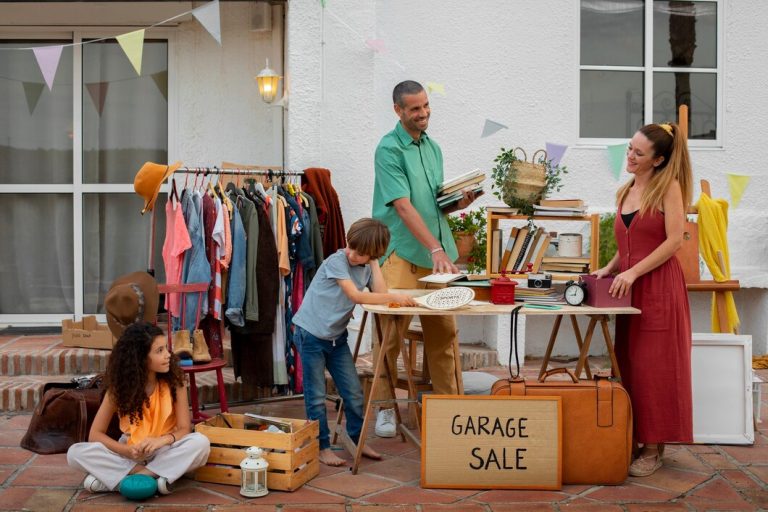
Did you know that the average electric power drill is used for a total of only 13 minutes in its entire lifetime? In a linear economy, every household is expected to own its own drill, its own ladder, and its own specialized kitchen appliances, regardless of how rarely they are used. This results in a massive “stagnant inventory” of resources sitting in garages and basements, representing billions of dollars in wasted capital and millions of tons of embodied carbon. We are surrounded by abundance, yet the linear system convinces us we are in a state of scarcity that can only be solved by a trip to a big-box store.
Buy Nothing groups and community exchanges are the antidote to this inefficiency. They represent the hyperlocal circular economy in its purest form—a system where goods move not through financial transactions, but through the power of a “gift economy.” This guide provides a strategic roadmap for navigating these networks, detailing how to join a Buy Nothing group, exploring the profound benefits of community gift economies, and teaching you how to revitalize your neighborhood by starting a local sharing network.
I. The Efficiency of the Gift Economy
We must move beyond the idea that an item’s value is only realized when it is sold.
The Problem of the “Transactional Friction”
The gift economy is a more efficient model for hyperlocal resource distribution than even the most optimized second-hand marketplaces.
Traditional selling (eBay, Facebook Marketplace) involves “transactional friction”—pricing, haggling, and the expectation of profit. This friction often prevents low-value but high-utility items (like a half-bag of potting soil or a stack of moving boxes) from moving at all; it’s simply “not worth the effort” to sell. In a hyperlocal circular economy, the price is removed. This lowers the barrier to entry, allowing resources to flow instantly to where they are needed most. By gifting, we reduce the “cost of disposal” for the giver and the “cost of acquisition” for the receiver, maximizing the total utility of the object.
A neighbor has a bag of baby clothes that their child has outgrown. If they try to sell them for 10, the clothes might sit in a closet for months. If they post them in Buy Nothing groups, a new parent three doors down picks them up that afternoon. The giver gets their space back instantly, the receiver saves money, and the community strengthens its bonds. No money changed hands, yet the “wealth” of the neighborhood increased significantly.
Therefore, participating in community exchanges is the most effective way to optimize local resource loops—it turns “idle junk” into “active community capital” with zero financial overhead.
II. How to Join a Buy Nothing Group and Participate Effectively
The Buy Nothing Project is a global movement with a specific set of rules designed to foster “abundance” rather than “scarcity.”
1. Finding Your Local Branch
Most Buy Nothing groups are hosted on Facebook or via the specialized Buy Nothing app.
- The Rule of Proximity: You are only allowed to join one group—the one where you actually live. This ensures the economy stays hyperlocal and reduces the carbon footprint of “gift pickups.”
- Search Strategy: Search for “Buy Nothing [Your Neighborhood Name]” on Facebook. If you can’t find one, you are likely in a “Buy Nothing Desert,” which is an opportunity for leadership.
2. The Three Pillars of Participation
- Give: Offer items you no longer need. From a surplus of garden tomatoes to a high-end stroller.
- Ask: Don’t be afraid to ask for what you need. A circular economy relies on people expressing their needs so that stagnant resources can be directed toward them.
- Gratitude: These groups run on social capital. A simple “thank you” or a photo of the item in its new home is the “currency” that keeps the loop moving.
III. Benefits of Community Gift Economies
Moving toward a hyperlocal circular economy provides returns that go far beyond simple waste reduction.
- Social Resilience: In a crisis, the neighborhood that knows who has a generator and who has a ladder is the neighborhood that survives. Neighborhood sharing builds “trust infrastructure.”
- Economic Relief: For families on a budget, community exchanges can provide up to 20-30% of their household needs—from furniture to clothing—for free.
- Waste Diversion: Hyperlocal sharing captures “micro-waste”—the small items that are too small to sell but too good to throw away—and keeps them out of the landfill.
IV. Starting a Local Sharing Network: Beyond Buy Nothing
If a formal group doesn’t exist, you can build the infrastructure of a hyperlocal circular economy yourself.
1. The “Little Free Library” Model
This concept can be expanded to “Little Free Pantries,” “Little Free Tool Sheds,” or “Little Free Seed Libraries.” These permanent structures allow for passive community exchanges without the need for digital coordination.
2. Tool Libraries
Partner with a local community center or library to start a tool sharing program. Instead of 50 households buying 50 lawnmowers, the community maintains 5 high-quality ones that are checked out as needed. This is the “Access over Ownership” model in action.
3. “Free Curb” Events
Organize a neighborhood-wide “Free Day” where everyone places unwanted items on their curb and neighbors are invited to “shop” for free. Anything left at the end of the day can be collectively hauled to a central donation center, reducing the number of individual trips made by cars.
V. The Strategic ROI of Gifting
| Household Item | Retail Cost (New) | Buy Nothing Acquisition | Circular ROI |
| High Chair/Baby Gear | 150.00 | 0.00 | 150.00 |
| Kitchen Stand Mixer | 300.00 | 0.00 | 300.00 |
| Moving Boxes (Set) | 40.00 | 0.00 | 40.00 |
| Gardening Tools | 60.00 | 0.00 | 60.00 |
- Zero-Waste Logistics: By picking up an item from a neighbor, you eliminate the packaging waste and the “last-mile” delivery emissions associated with online shopping.
- Mental ROI: The psychological shift from “What can I get for this?” to “Who can I help with this?” reduces the stress of clutter and builds a sense of belonging.
VI. Why Hyperlocalism is the Future of Circularity
In a world of global supply chain disruptions, the hyperlocal circular economy is the ultimate insurance policy. It relies on “distributed inventory.” Your “warehouse” is actually the garages of the people living on your street.
By practicing neighborhood sharing, we are decentralizing the economy. We are making it smaller, slower, and more human. This is not “poverty”; it is “shared prosperity.” It is the realization that we already have everything we need, provided we are willing to share it with one another.
Conclusion: The Neighborhood as a Loop
The circular economy is often discussed in terms of industrial recycling plants and corporate logistics, but its most powerful expression is a neighbor handing a bag of outgrown clothes to another neighbor across a fence.
How to join a Buy Nothing group is the first step toward a more resilient life. By embracing community exchanges and recognizing the benefits of community gift economies, you transform your street from a row of isolated consumers into a thriving, self-sustaining ecosystem. The loop starts at your front door—open it, give what you can, and watch as your community becomes wealthier in the ways that truly matter.
About the Author