Did you know that the average traveler replaces their luggage every three to five years, usually due to a single mechanical failure like a jammed zipper or a cracked wheel? In a linear economy, these high-utility items are treated as disposable commodities, yet they are constructed from some of the most durable “technical nutrients” available—ballistic nylon, polycarbonate, and high-grade aluminum. When we discard a suitcase because a strap frayed or a zipper split, we aren’t just losing a bag; we are throwing away the immense energy and specialized engineering required to manufacture those durable materials.
Backpack repair and luggage repair are essential pillars of a circular lifestyle. By shifting our perspective from “replacement” to “restoration,” we can extend the life of our travel gear by decades. This guide provides a definitive roadmap for fixing zippers, detailing how to repair a torn backpack, and providing actionable steps for DIY backpack strap reinforcement. By the end of this article, you will have the skills to ensure your gear stays on the road and out of the landfill.
I. The Material Integrity of Travel Gear (The OREO Framework)
The high-performance materials used in modern luggage are designed for extreme stress, making them perfect candidates for repair rather than replacement.
The Problem of Single-Point Failure
Opinion: Discarding a 200 backpack or a 500 suitcase due to a single torn seam or a broken buckle is a catastrophic failure of resource management and personal finance.
Reason: Most luggage failures occur at “interface points”—places where different materials meet, such as zippers, wheels, and strap attachments. The core body of the bag is usually still perfectly intact. Because these items are made of complex synthetics that are notoriously difficult to recycle, every bag saved from the trash prevents a permanent addition to the plastic waste stream while saving the consumer the high cost of a replacement.
Example: A traveler has a premium suitcase with a shattered wheel. The manufacturer suggests buying a new model because that specific wheel is “discontinued.” In the linear model, that bag is now waste. In the circular model, the traveler uses a universal replacement kit found online for 15. With 20 minutes of labor, the bag is back in service. They saved hundreds of dollars and kept 10 kilograms of high-grade plastic and aluminum in circulation.
Opinion/Takeaway: Therefore, luggage repair is not a hobby for the frugal; it is a critical skill for the circular economy that preserves high-value materials and de-risks our travel investments.
II. How to Repair a Torn Backpack: Fabric Restoration
Backpacks often suffer from “abrasion tears” or “snags.” Because backpack fabric (usually Cordura or Ripstop nylon) is under constant tension, the repair must be stronger than the original weave.
The Patch and Seal Method
- Clean and Prep: Use a mild detergent or alcohol wipe to remove dirt and oils from the tear area.
- Internal Reinforcement: If the hole is large, apply an adhesive patch (like Tenacious Tape) to the inside of the bag first. This provides a stable base for the external fix.
- The External Patch: Cut a second patch for the outside. Crucially, round the corners of the patch to prevent them from catching on edges and peeling off.
- Edge Sealing: For heavy-duty use, apply a thin bead of flexible urethane adhesive (like Seam Grip) around the edges of the patch. This prevents moisture from getting under the adhesive and ensures the backpack repair is permanent.
III. Fixing Zippers: The Most Common Failure
A “broken” zipper is rarely actually broken; usually, it is just a worn-out slider.
1. Replacing the Slider
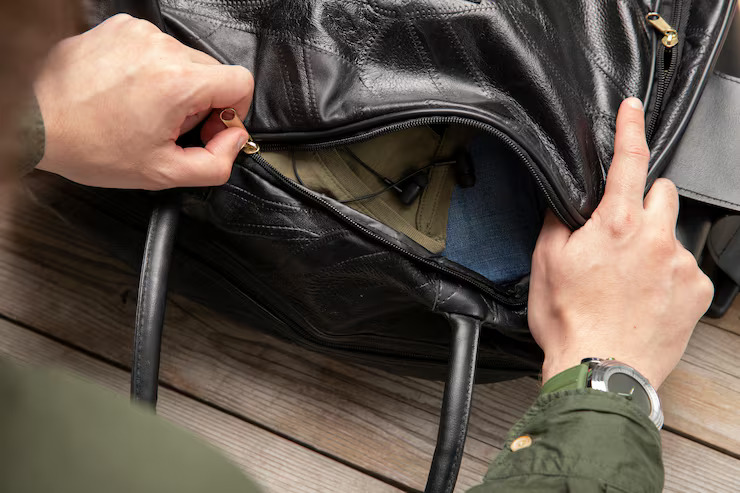
If the zipper teeth are separating behind the slider, the slider’s “jaws” have likely stretched open. You can often fix this by gently squeezing the sides of the slider with needle-nose pliers. If that fails, you can purchase a “top-stop” replacement kit, slide the old slider off, and put a new one on. This is the #1 most effective luggage repair trick.
2. Lubrication and Cleaning
Zippers on luggage are exposed to salt, sand, and grime. A zipper that feels “stuck” often just needs a cleaning. Use a toothbrush to scrub the teeth, then apply a dry lubricant like paraffin wax or a specialized zipper stick. Fixing zippers through maintenance prevents the metal from grinding down and failing prematurely.
IV. DIY Backpack Strap Reinforcement and Replacement
Straps bear the entire weight of your load, making them the most common point of structural failure.
- Reinforcing a Frayed Strap: If a strap is starting to pull away from the seam, do not wait for it to fail. Use a “Box-X” stitch—a square of stitching with an ‘X’ in the middle—to distribute the weight across a larger surface area of the fabric.
- Buckle Replacement: If a plastic buckle snaps, do not sew a new one on. Purchase a “Field Repair Buckle,” which features a removable pin that allows you to replace the buckle without any sewing required. This is a vital part of luggage maintenance.
V. Fixing Luggage Wheels and Handles
Hard-shell luggage usually fails at the wheels or the telescopic handle.
- Wheel Replacement: Most modern suitcases use “bolt-on” wheel housings. If a wheel melts or cracks, you can unscrew the interior lining of the suitcase to access the bolts. Universal inline-skate style wheels are often more durable and smoother than the originals.
- Handle Lubrication: If a telescopic handle is sticking, do not force it. Spray a small amount of silicone lubricant into the sliding tracks. If the handle is bent, it can often be straightened using a pipe-straightening technique, though this requires careful pressure to avoid snapping the aluminum.
VI. The ROI of Gear Longevity
Repairing your travel gear provides a massive return on investment. Below is a comparison of typical costs:
| Item | New Purchase Cost | Repair Cost (DIY) | Years Added |
| High-End Suitcase | 450.00 | 20.00 (Wheels) | 5-10 Years |
| Hiking Backpack | 280.00 | 12.00 (Buckle/Tape) | 3-5 Years |
| Daily Commuter Bag | 120.00 | 5.00 (Slider) | 2-4 Years |
By choosing backpack repair and luggage repair, you aren’t just saving money; you are opting out of a cycle of waste.
Conclusion: The Resilient Traveler
The true mark of an experienced traveler isn’t a pristine bag; it’s a bag with stories to tell and repairs that prove its resilience. Fixing zippers, patching tears, and reinforcing straps are the skills that turn a disposable product into a lifelong companion.
How to repair a torn backpack is a simple process once you have the right tools. By committing to luggage maintenance and mastering DIY backpack strap reinforcement, you become a steward of the circular economy. Your gear was built to go the distance—make sure you give it the care it needs to get there.
About the Author