Did you know that the lifespan of household appliances has decreased by an average of 20% over the last two decades? The linear economy thrives on this planned obsolescence, encouraging consumers to discard a toaster with a broken lever or a dishwasher with a faulty pump, contributing massively to the 50 million metric tons of e-waste generated globally each year.
The simplest, most powerful act of circularity you can perform is demanding longevity for your possessions. Appliance repair is central to the circular economy—it retains 100% of the material’s value and saves you the high cost of replacement. This kitchen appliance repair guide provides the definitive playbook for adopting the “repair-first” mindset, detailing how to repair kitchen appliances yourself safely, and offering clear guidance on when to repair vs replace appliances by weighing financial and circular factors.
I. The Repair Imperative: E-Waste and Obsolescence (The OREO Framework)
The assumption that replacing a broken small appliance is cheaper and easier than appliance repair is a myth perpetuated by manufacturers who prioritize sales volume over durability.
The True Cost of “Easy” Replacement
Opinion: Discarding a kitchen appliance simply because one component has failed is a profound act of economic and environmental self-sabotage.
Reason: When you replace a broken blender, you are incurring a massive hidden cost: the raw material extraction, the manufacturing energy, and the transportation associated with the new product. This cost often dwarfs the expense of a single replacement part. The linear system intentionally makes parts and manuals difficult to obtain to push you toward the profitable act of repurchase.
Example: Your food processor stops working. The internal motor is fine, but the cheap plastic gear connecting it to the blade has stripped. The new processor costs $120. A quick search reveals the replacement gear costs $10, and the DIY appliance fix takes 15 minutes with a screwdriver. By choosing repair, you save $110 and prevent the e-waste of an entire, otherwise functional machine. The circular choice retains value, the linear choice destroys it.
Opinion/Takeaway: Therefore, the decision of when to repair vs replace appliances must always be weighted heavily toward repair, making the kitchen appliance repair skillset one of your most valuable circular assets.
II. Step 1: Appliance Maintenance for Prevention
The best repair is the one you never have to make. Basic, regular appliance maintenance can prevent the most common failures.
- Dishwasher: Regularly clean the filter screen at the bottom. Check the spray arms for clogged holes. Use a descaling cycle monthly to prevent mineral buildup on heating elements.
- Refrigerator: Clean the condenser coils (located at the bottom or back) twice a year. This prevents overheating and preserves the motor’s life. Check and clean the drain pan.
- Toaster/Toaster Oven: Unplug and regularly empty the crumb trays. Burnt crumbs are the leading cause of odors and are a fire hazard.
- Washing Machine (Kitchen-adjacent): Run an empty hot cycle with vinegar or a specialized cleaner monthly to eliminate mold, mildew, and detergent residue that damage seals.
III. Step 2: DIY Appliance Fix vs. Professional Service
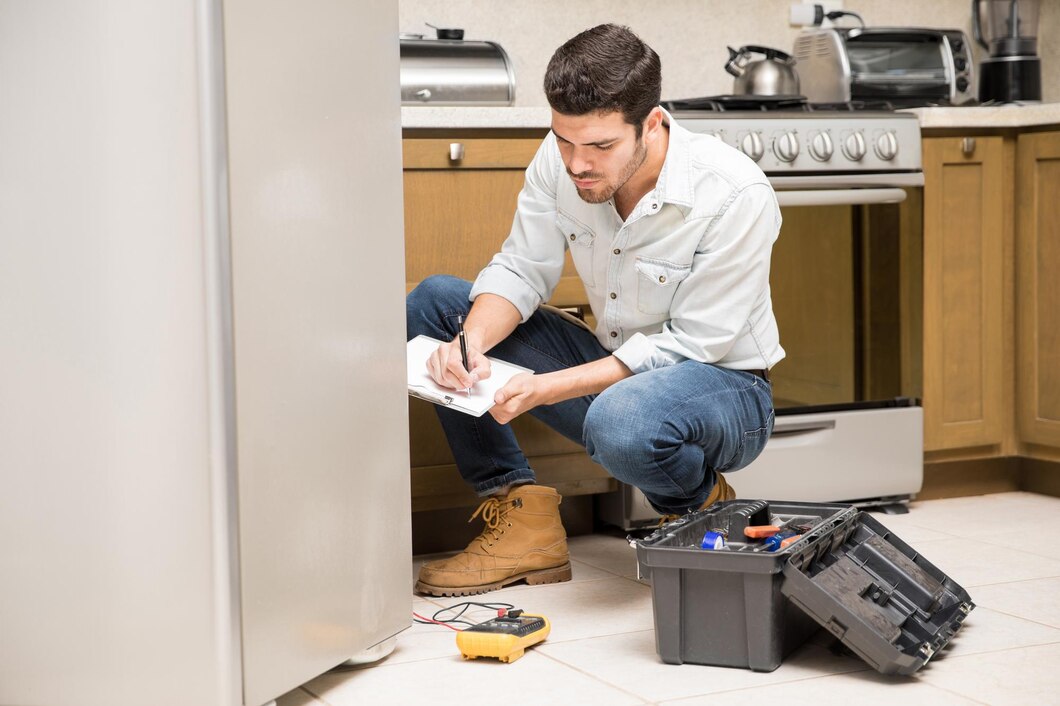
When something breaks, use a simple triage method to decide if you need to call a technician. This helps you figure out how to repair kitchen appliances yourself.
How to Repair Kitchen Appliances Yourself (The DIY Zone)
The DIY zone includes minor mechanical failures that do not involve high-voltage electricity, gas, or sealed refrigeration units.
- Small Appliance Diagnostics:
- The Cord/Plug: Check if the power cord is damaged or if the wall outlet itself is dead.
- External Fuses: Many small blenders or coffee makers have a thermal fuse accessible via the base that can be easily tested and replaced.
- Simple Mechanical Failure: Broken knobs, clogged filters (dishwashers, vacuums), stripped gears on mixers/blenders, and failed door seals on refrigerators.
- Key Tool: The internet is your library. Use sites like iFixit, YouTube, and the appliance manufacturer’s parts diagrams (if available) to find replacement parts and step-by-step videos. Always unplug the appliance before opening.
When to Repair vs Replace Appliances (The Professional Zone)
Call a professional (or consider replacement) for major structural failures or hazards:
- Refrigeration/Freezer Unit: Any issue involving the sealed refrigeration system (compressor failure, refrigerant leaks). These contain hazardous chemicals and high-pressure components.
- Gas Appliances: Ovens, cooktops, and gas dryers. Gas leaks pose serious fire and explosion risks.
- Major Electrical Failure: When the main control board or motor on a large, high-voltage appliance (e.g., oven, dishwasher) has completely failed. Note: Repair is often possible but requires specialized training.
IV. The Financial Test: Repair vs Replace Cost Analysis
The crucial financial question is the 50% Rule: If the cost of the repair (parts + labor) exceeds 50% of the cost of a brand-new equivalent appliance, it’s time to consider replacement, but only if the replacement is demonstrably more energy-efficient.
| Scenario | Repair Cost | New Cost | Decision | Circular Rationale |
| Old Dishwasher: Needs a 300 pump (New is 800). | 37.5% | 800 | Repair. | Retains 100% material value; pump replacement extends lifespan by years. |
| Old Fridge (15 years): Needs a 600 compressor (New is 1,100). | 55% | 1,100 | Replace. | New fridges have far better energy efficiency; the operating cost savings justify the material input. |
| New Blender (1 year old): Needs a 10 gear (New is 80). | 12.5% | 80 | DIY Fix. | The product’s embodied energy has barely been used; replacement is pure e-waste. |
Conclusion: The Right to Repair
The mindset of DIY appliance fix and professional kitchen appliance repair is the engine of the circular economy at home. By adopting simple appliance maintenance habits and consciously seeking out replacement parts, you defy planned obsolescence and become a resource steward.
Always prioritize repair over replacement. The question is not just can it be fixed, but must it be fixed to preserve the value already created. Embrace the toolkits and online guides—the power to extend the life of your appliances, reducing e-waste, is truly in your hands.
About the Author