Did you know that recycling, the action most people associate with sustainability, is actually one of the least effective ways to reduce your environmental footprint? The simple act of putting a plastic bottle in a blue bin requires energy, transport, and infrastructure, making it an economically and ecologically costly last resort. If you want to move beyond the guilt of simple recycling and become a true champion of the circular economy framework, you need a new vocabulary, a new checklist, and a new mindset.
The 7 Rs circular economy model provides exactly that. This comprehensive approach expands the original “3 Rs” (Reduce, Reuse, Recycle) into a powerful hierarchy that prioritizes actions that save more energy, materials, and money. It is the roadmap for turning the abstract idea of a circular economy into a tangible, day-to-day reality for individuals and businesses.
This guide will master the full spectrum of the 7 Rs circular economy—from Refuse to Recycle—and show you exactly how to apply 7 Rs at home and in your business.
I. The Fundamental Shift: Understanding the Circular Economy Hierarchy Explained
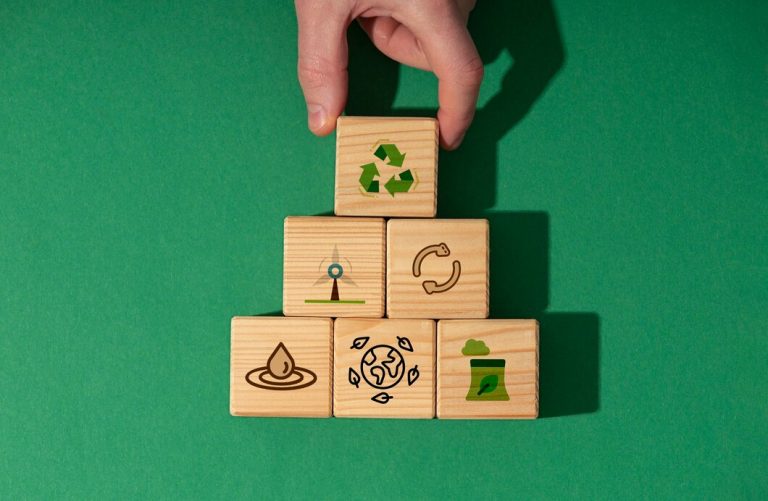
Before diving into the Rs, it is essential to understand that they are not equal. They form a waste hierarchy, a pyramid of importance where actions at the top offer exponentially greater benefits than those at the bottom.
The Power of Prevention (The OREO Framework)
Opinion: The only truly sustainable product is the one that is never made in the first place.
Reason: Every manufactured good carries an enormous “embedded energy” cost (the energy required for extraction, processing, transport, and manufacturing). Eliminating consumption at the source—the top of the circular economy framework—is the only way to avoid that environmental impact entirely.
Example: Think about a paper receipt. The moment you Refuse the printed receipt and opt for an email instead, you save the trees, the water, the printing ink, the energy for the machine, and the potential waste management of the physical paper. No other “R” can match that zero-impact outcome.
Opinion/Takeaway: Therefore, for true 7Rs sustainability, your primary goal must be prevention: the powerful combination of Refuse and Reduce.
II. The Preventative Rs: Refuse, Reduce, and Rethink
These are the most impactful steps in the circular economy hierarchy explained. They tackle the problem before it becomes a problem.
1. Refuse (The Absolute Best Choice)
This means saying NO to what you don’t need. It is about blocking the flow of waste into your life or business.
- Household Example: Refusing single-use plastic bags, straws, take-out cutlery, junk mail, and unnecessary packaging.
- Business Example: Refusing to accept excessive packaging from suppliers. Refusing to produce non-recyclable promotional materials.
2. Reduce (Minimizing Input)
This means buying or using less of everything. It requires careful planning and conscious consumption.
- Household Example: Planning meals to minimize food waste, downsizing a subscription plan, or simply buying fewer clothes per year.
- Business Example: Digitalizing operations to reduce paper and toner use, switching to concentrated cleaning products, or optimizing packaging sizes to reduce material per unit.
3. Rethink (The Design Element)
This is a mindset that applies mostly to businesses and product designers, but households can participate by choosing brands that have already done the rethinking. It means considering the end-of-life before the start of the life.
- Focus: Designing products to be durable, modular (easy to upgrade), and non-toxic, ensuring they can easily enter a circulation cycle.
- The Key: Asking, “Can this entire product or material be regenerated, composted, or endlessly circulated?”
III. The Extended Rs: Reuse, Repair, and Refurbish
Once a resource is in your possession, the next priority is to extend its functional life through refuse reduce reuse strategies. These steps retain the item’s original value, saving manufacturing costs.
4. Reuse (Giving an Item a Second Life)
This is about using an item again for its original purpose or a different one without significant alteration.
- Household Example: Washing and reusing glass jars for storage, using old bedsheets as cleaning rags, or passing down clothes to a younger sibling.
- Business Example: Using reusable shipping containers for inter-site logistics, or accepting clean, undamaged customer packaging back for re-use.
5. Repair (Valuing Functional Longevity)
The skill of fixing things is central to the 7 Rs circular economy. It directly challenges the linear model’s planned obsolescence.
- How to Apply 7 Rs at Home: Learning simple mending techniques for clothing, fixing appliances with spare parts (instead of replacing the entire unit), or taking electronics to a local repair shop.
- Business Example: Offering in-house repair services for products long after the warranty expires (a revenue stream, not a cost), or stocking spare parts for all products for a minimum of ten years.
6. Refurbish (Bringing Old to New)
Refurbishment involves cleaning, repairing, and improving an item to bring it back to a “like-new” condition, often with an updated style or component.
- Focus: Selling certified refurbished electronics (laptops, phones) or renewing vintage furniture with new upholstery and finishes. This is a common practice in the professional equipment sector, such as medical devices or large engines.
IV. The Final Rs: Repurpose and Recycle
These last two Rs are the critical final steps that ensure resources do not become waste. They focus on material recovery when an item’s functional life is truly over.
7. Repurpose (Creative Re-imagining)
Repurposing means using a product for a completely different function than originally intended. The product is not returned to factory specifications, but its material or structure is used in a new way.
- Example: Turning old tires into garden planters, transforming broken ceramic plates into mosaic tiles, or converting shipping pallets into indoor furniture.
8. Recycle (The Last Resort)
Recycling is the process of breaking down a product into its base materials to be reprocessed into a new product. In the circular economy framework, this is the least-preferred option because it requires significant energy, and often results in a loss of material quality (downcycling).
- Actionable Step: When you do recycle, focus on high-quality, high-value materials (aluminum, glass, PET plastics, cardboards) and ensure they are clean and correctly sorted to maximize their chance of actually being converted into a new product.
Summary of the Waste Hierarchy (7Rs Sustainability)
Best (Prevention): Refuse, Reduce, Rethink Better (Life Extension): Reuse, Repair, Refurbish Good (Material Recovery): Repurpose, Recycle
Conclusion: Mastering the 7 Rs Circular Economy
The journey from a linear system to a fully circular one is not a leap; it is a ladder climbed step-by-step using the 7 Rs circular economy as your guide. By consciously prioritizing Refuse and Reduce over Recycle, you move yourself and your community up the waste hierarchy.This circular economy framework is more than just a list of things to do; it is the definitive philosophy for how resources should be managed in a modern, sustainable economy. Applying the circular principles in your household or business will not only shrink your environmental shadow but also build resilience and generate cost savings, proving that circularity is the only truly viable path forward.
About the Author